Google Ads passkeys: the deadline is 19 August, the wait is seven days
Google Ads starts requiring a passkey for sensitive actions on Wednesday 19 August 2026, and a new key carries a documented security wait of up to seven days. The stretch of calendar in which starting early bought you margin has closed. So the question is no longer when to start — it is what still works if the wait lands on your key.
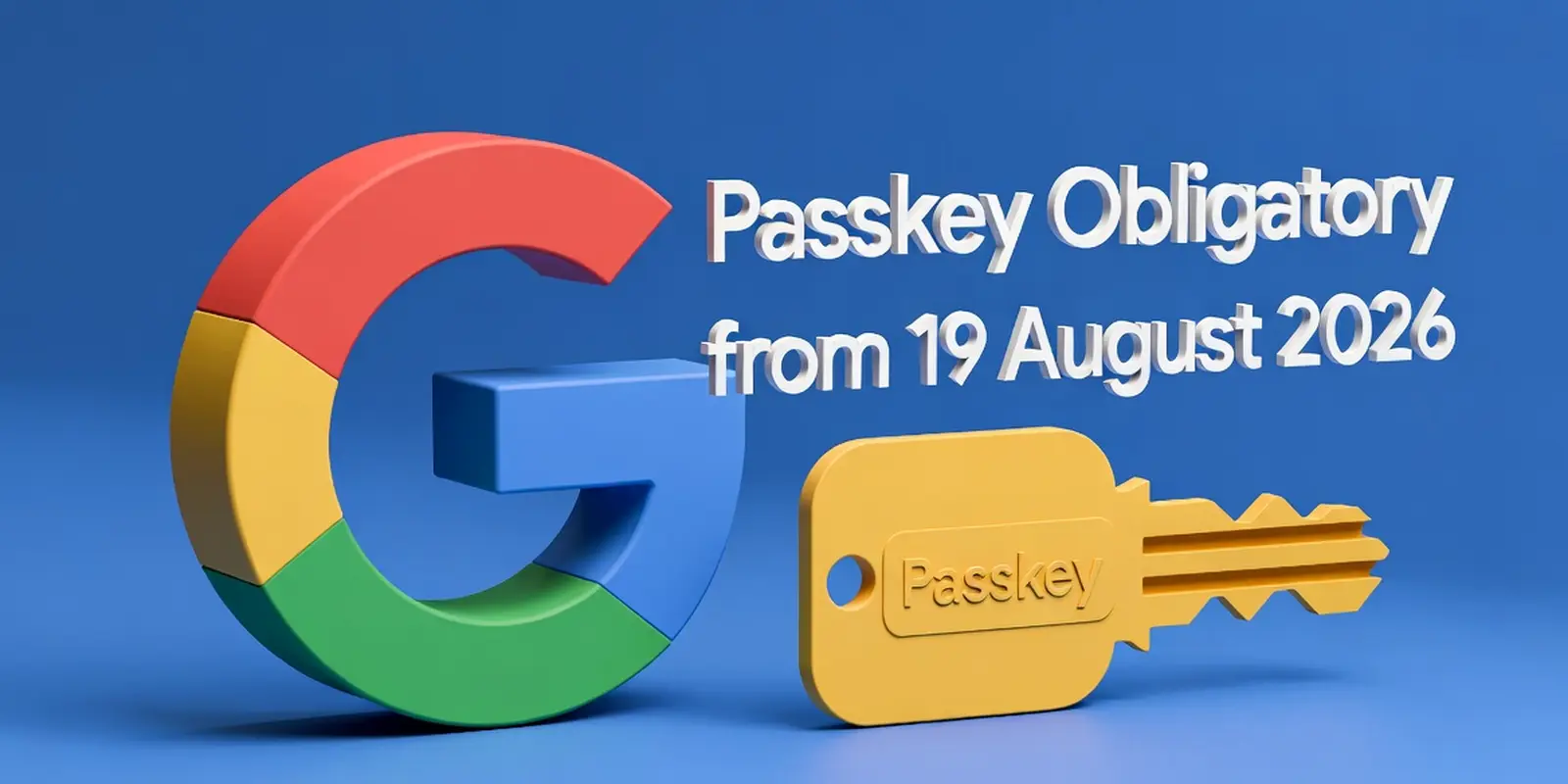
What changes. From 19 August 2026, a handful of operations inside a Google Ads account — adding a user, changing someone's permissions, linking to a manager account, editing payment details — require a passkey. Not a password, not an SMS code.
Why it may not be your problem. If nobody touches the structure of your account, your campaigns keep running and you may never meet this screen. If you switch agencies, change cards, or grant access, you stop right there.
What you get from reading. The arithmetic almost nobody has done, plus the second half of the story: accounts signed in from a free email address are losing the right to perform exactly these actions.
- Why a key created on 18 August is a key created too late.
- The four operations that get blocked, so you can tell in ten seconds whether this concerns you.
- What to ask the vendor of any tool connected to your Ads account.
- Why the account password can no longer be handed to whoever runs your ads.
Start with the arithmetic, because it is the part that changes what you do today.
Google's own documentation describes three waiting thresholds for a new passkey: a day or two before the key is associated with Google Ads, 48 hours recommended before using it for sensitive activity, and a security waiting period that can reach seven days. Trade coverage puts it more bluntly: a new key can take up to seven days before it actually works.
The deadline is 19 August. Seven days earlier was 12 August, which is behind us. That subtraction is the whole article — the rest is what happens when the answer comes out negative, which for anyone reading this now it does.
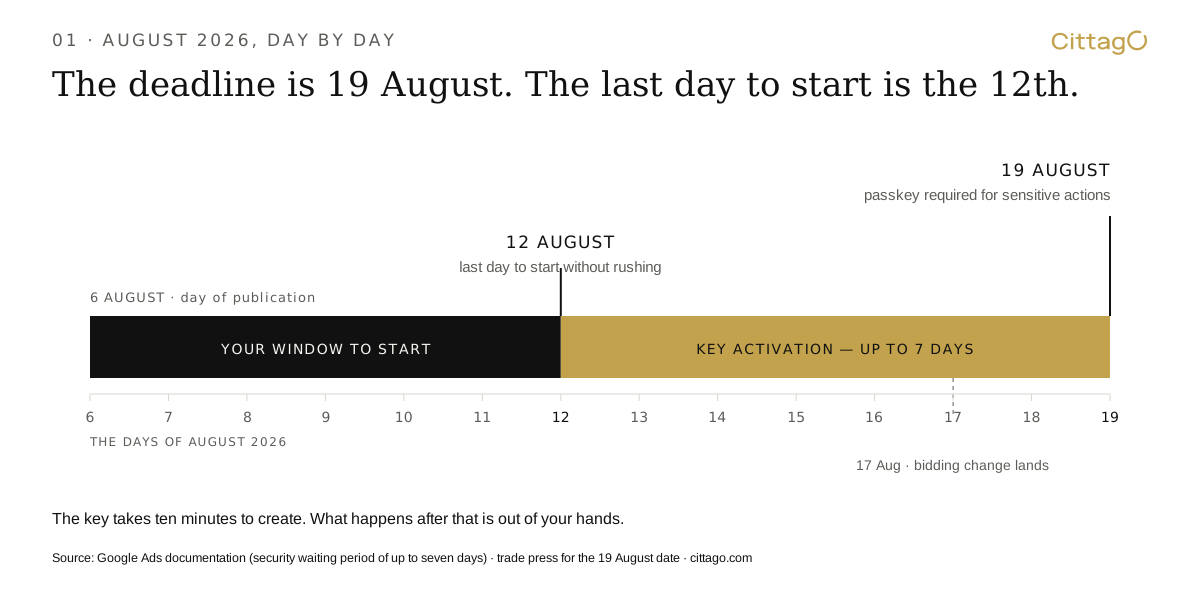
This is the date, and the subtraction that runs through this article has run out. A key created on 19 August carries its seven-day security window to 26 August, a week past the requirement; even the 48-hour recommendation now lands on 21 August, two days late. There is no arrangement of the calendar left that puts a brand-new key inside the deadline.
Re-read on the morning of 19 August on Google's page Use a passkey to complete sensitive actions, in English, Romanian and Italian: the seven-day sentence is unchanged, the fallback sentence is unchanged, and none of the three carries a calendar date of any kind. There is no confirmation screen for the day. The 19 August date still travels by account notification and trade press only — which is worth saying plainly on the day it takes effect, rather than implying a certainty Google has not published.
What is left is unglamorous and still worth doing: create the key, and expect to fall back on your existing sign-in verification for anything sensitive that cannot wait out the security window. Google's own sentence covers that path — during the delay, “You should be able to complete actions using other authentication workflows.”
We opened that help page in all three of our languages this morning, because the seven-day wait is the number the article turns on. English and Romanian phrase it as a possibility: “New passkeys may be subject to a 7-day security delay”, and “Cheile de acces noi pot fi supuse unei perioade de așteptare de securitate de șapte zile”. The Italian page states it as a rule: “Le nuove passkey richiedono un periodo di attesa di 7 giorni per motivi di sicurezza” — new passkeys require a seven-day wait.
Same page, same morning, and a conditional in two languages is an obligation in the third. Read Google in Italian and you would plan for a certain week of waiting; read it in English and you would plan for a risk. We cannot tell you which one the system does — only that Google describes it both ways, and that the cautious reading is the Italian one.
What changes on 19 August
Signing in does not change. Campaigns keep running untouched. What changes is a narrow set of operations Google calls sensitive — the ones through which somebody who stole your account could take it away for good.
- Adding a new user to the account.
- Changing the permissions of someone who already has access.
- Accepting a new manager account (MCC) link or editing existing ones.
- Changing payment information — card, billing details, invoicing.
Every blocked operation has the same shape: you perform it once every couple of years, and when you do, it is urgent.
What a passkey is
Definition: a passkey is a personal access key stored on your phone or computer and unlocked with your fingerprint, face or screen code, which replaces the password when Google needs to be certain it is really you.
Google Ads documentation is unusually direct about the consequence: a passkey is always personal, it is a unique cryptographic credential bound to one person's device and biometric profile, and it cannot be shared among a group. That single sentence is what breaks the habit half the market runs on.
The API deadline that has already passed
There is a second, separate change, and it is already in force. Since 5 August 2026, the Google Ads API requires a passkey when new credentials are generated — specifically, new OAuth 2.0 refresh tokens. The announcement went up on Google's Ads developer blog on 27 July.
This sounds like a developer problem until you follow it through. Any tool wired into your account — a reporting dashboard, a bid script, an inventory sync — eventually re-establishes its connection. When it does, it asks for a passkey from the person who authorised it. If that person has left the company, you have a small problem with a timer on it.
Since 1 August we have been running two in-house tools that read Search Console and Analytics data automatically and feed our monthly reporting. Checked in the code: both authenticate through a service account, signing a JWT with its own key, rather than through a person's authorisation. Service-account workflows sit outside the 5 August requirement — they are, in fact, the recommended path for automation. So nothing breaks on our reporting side. The useful part is the question it hands you: ask your vendor whether the connection runs on a service account or on one person's authorisation.
Free email domains lose the right to these actions
Running alongside the passkey requirement is a second restriction, and it gets far less coverage. Accounts accessed from free email domains — @gmail.com, @yahoo.com and the rest — are being blocked from completing sensitive actions; the user has to move to a corporate email domain. I read it on Search Engine Roundtable on 6 August, and Google describes it in a help page separate from the passkey one.
Everything else stays: reports, ordinary campaign edits, all according to your access level. Only the four operations above are affected. And the status matters — Google's documentation calls it a pilot: „This update is currently being piloted for a subset of advertisers. You will receive an email notification if your account is enrolled.”
For a ten-person company this is rarely a hypothetical. The Ads account frequently sits on the founder's personal address, or on the address of a contractor who set it up years ago. We see it on nearly every account handover. We wrote about the economics of those accounts in Google Ads costs by industry.
What you need before you start
- A device with a screen lock enabled — fingerprint, face or code. The passkey leans on it.
- A recent enough operating system: Windows 10 or newer, macOS Ventura or newer, Android 9.0 or newer, iOS 16 or newer. A FIDO2 hardware security key works too.
- A recent enough browser: Chrome 109+, Safari 16+, Edge 109+, Firefox 122+.
- Access to the Google account you sign into Google Ads with — the passkey is created at Google account level, not inside Google Ads.
- Time before the deadline. The ingredient everyone forgets.
How to set it up in ten minutes
- Open the Google account you use for Google Ads — not Google Ads itself, but the security settings of the Google account.
- Find „passkeys” and create one on the device you actually work from.
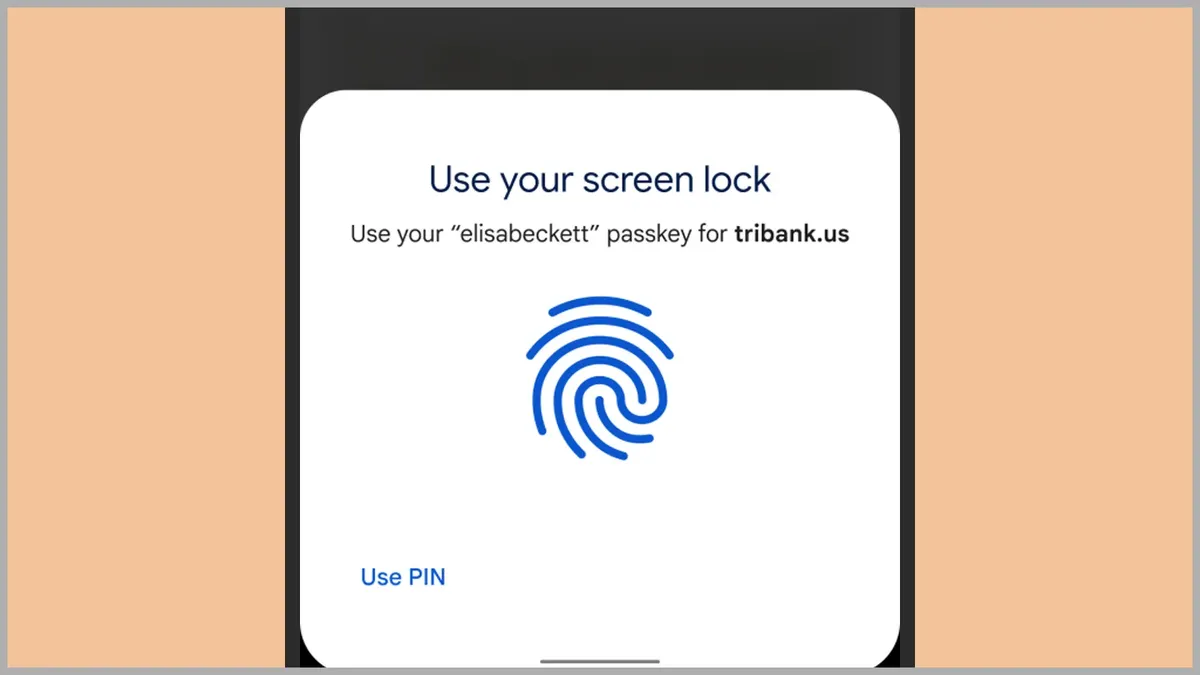
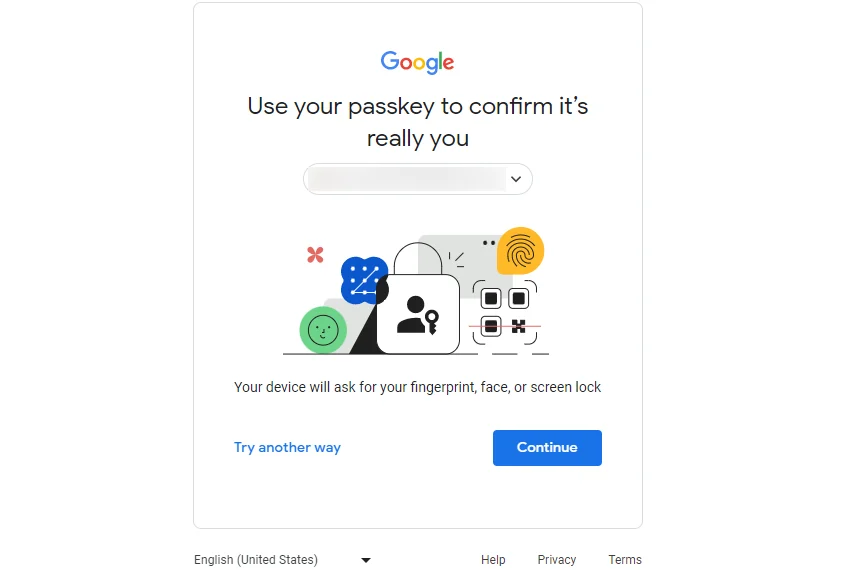
- Confirm with fingerprint, face or screen code. Nothing new to invent or memorise.
- Repeat on a second device. This is the step everyone skips and the one that matters most: one key on one phone means a lost phone is a locked account.
- Put a reminder in your calendar seven days out. Until then, verify rather than assume.
- While you are in there, look at who else has access. There is almost always an address you did not expect.
One more setting, unrelated to the August announcements and worth more than both: Google Ads has long had allowed email domains. Set your company domain and the account can no longer be invited to outside addresses — set „example.com” and you can invite [email protected] but not [email protected]. It takes one pass through the settings and prevents a whole class of problems.
| Operation | Until now | From 19 August 2026 |
|---|---|---|
| Signing in | Password plus two-step verification | Unchanged |
| Campaign edits | No extra verification | Unchanged |
| Adding a user / changing permissions | Done straight from the account | Requires a passkey |
| Linking to a manager account | Accepted with one click | Requires a passkey |
| Changing payment details | Done straight from the account | Requires a passkey |
What a passkey does not do
- It does not protect your budget from a badly built campaign. This is an access control, not a performance feature.
- It does not stop someone with legitimate access from doing damage. Permissions are still permissions.
- It does not replace your password at sign-in.
- It does not transfer between people. When the person leaves, the key leaves — a process problem, not a technology one.
- It does not fix company accounts held on personal addresses. Allowed domains do that.
What these announcements do not say
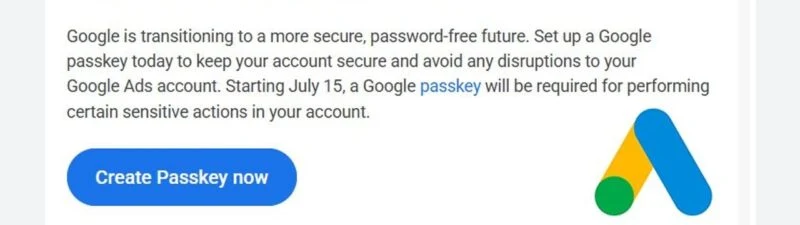
First: the 19 August date comes from trade coverage — a German site that has tracked the story from the start, and an English write-up — not from an official Google page I can link to. The original email, shown above, said 15 July. If Google moves it again, this page gets updated.
Second: the free-address restriction is a pilot. I do not know how large the enrolled group is, or whether it becomes universal.
Third: there is no published figure for how many company accounts run on free email addresses, in any market. Nobody measures it, and I am not going to estimate it. What we can offer is what we see on account handovers, which is an observation rather than a statistic.
Glossary
| Term | What it means in your account |
|---|---|
| Passkey | A key kept on your phone or laptop, unlocked with a fingerprint or screen code. It has no text form, so there is nothing to send anyone. |
| Sensitive action | Adding a user, changing permissions, linking to a manager account, changing payment details. |
| Manager (MCC) account | The account an agency runs multiple clients from. Accepting a link counts as sensitive. |
| Free email domain | @gmail.com, @yahoo.com and similar. The opposite is an address on your own company domain. |
| OAuth refresh token | The piece of authorisation that keeps an external tool connected to your account. Generating a new one has required a passkey since 5 August. |
| Service account | A technical account with no person behind it, used by automation. Outside the passkey requirement. |
The dates, and where each one comes from
| Date | What happened | Where I read it |
|---|---|---|
| 8 May 2026 | Google emails advertisers with „Create Passkey now” | ppc.land |
| 15 July 2026 | The deadline announced in that email | the Google email (shown above) |
| 27 July 2026 | Google announces the API passkey requirement | Google Ads developer blog |
| 5 August 2026 | Requirement takes effect for new OAuth tokens | trade coverage of the Google announcement |
| 6 August 2026 | Free-address restriction surfaces | Search Engine Roundtable |
| 19 August 2026 | Passkey required for sensitive actions | conversion-traffic.de, decantery.com |
One calendar note worth seeing whole: 17 August is when the bidding change we covered two weeks ago in the target CPA article lands. Two Google deadlines in one week, on two different layers of the same account.
Where you stand, in three thresholds
Threshold 1 — personal address, no passkey. The most exposed position and the longest list. In order: create the key today, audit who has access, then plan the move to a company address. Not all in one day, and not on 18 August.
Threshold 2 — company domain, no passkey. One task, ten minutes plus a week of waiting. Do it today and diary the check.
Threshold 3 — passkeys on two devices, allowed domains set. Nothing to do on 19 August. Just review the tools connected through the API and ask their vendors what kind of authorisation they run on.
If you are at threshold 1 and somebody else has held the account for years, this is a good moment to look at how that relationship works. We run Google Ads account management for companies in Romania and Italy, and the first thing we check on handover is exactly what this article asked you to check: who has access, on which addresses, and who actually owns the account.
Ten questions about passkeys, answered briefly
Do my campaigns stop if I do nothing?
No. Campaigns keep running and signing in is unchanged. Only the four sensitive operations are blocked.
The risk is not today. It is the day you urgently need one of those operations and find out you have seven days of waiting ahead of you.
Is this the same as two-step verification?
No. Two-step verification protects the sign-in. A passkey is required at the moment of the sensitive action, and an SMS code does not substitute for it.
The practical difference: a code can be read out loud to someone. A passkey cannot.
Does this apply outside the United States?
Yes — it is a platform change, not a regional policy. The free-address restriction is the part that is limited, and it is limited by pilot group rather than by country.
What happens to Google Ads Editor and third-party tools?
They fall under the 5 August change, which applies when new credentials are generated. An existing connection does not break; it re-authorises eventually, and at that point a passkey is requested.
Ask the vendor whether they connect through a service account. If they do, this does not apply to them.
Can I use a hardware security key instead of my phone?
Yes, as long as it is FIDO2 compatible. It is a good option if you would rather not tie account access to a phone.
The two-device rule still stands. One key is one point of failure.
My agency holds the account. Who creates the passkey?
Whoever performs the sensitive action. If the agency accepts the manager link, the agency needs the key; if you accept it, you do.
It is also a reasonable moment to settle a question that often stays vague: who owns the account. Ownership belongs with the company, not with whoever administers it.
Does this affect Merchant Center, Analytics or Search Console?
The announcements covered here are specific to Google Ads and to the Google Ads API. Other Google products have their own security settings and their own timelines.
That said, a passkey is created at Google account level, so making one covers you wherever Google later asks for it.
Can I have more than one passkey on the same account?
Yes, and you should. One per device is the sensible baseline — a laptop and a phone, or a phone and a hardware key.
Each new key can carry its own waiting period, which is another argument for creating the second one now rather than after you lose the first.
What if I simply ignore all of this?
Nothing happens on 19 August. The cost shows up later, at the worst possible moment: a card expires, an agency changes, a new colleague needs access, and the operation you need is behind a key you have not created.
Recovery is not dramatic — it is just slow, and slow is expensive when the account is spending money every day.
How do I know whether my account is in the free-address pilot?
By notification. Google sends an email and shows an in-product message when the feature is active on your account.
With no notification, assume you are not enrolled — but treat that as a postponement rather than an exemption.
Last updated: 19 August 2026, the day the requirement takes effect. The 19 August 2026 date for sensitive actions comes from trade coverage (conversion-traffic.de, decantery.com); Google's original email, reproduced in the article, announced 15 July. Re-read on 19 August 2026 on Google's page Use a passkey to complete sensitive actions, in English, Romanian and Italian: none of the three carries a calendar date, and the seven-day wait is present in all three but not with the same force — conditional in English ("may be subject to a 7-day security delay") and in Romanian ("pot fi supuse"), stated as a requirement in Italian ("richiedono un periodo di attesa di 7 giorni"). All three keep the sentence saying actions can still be completed through other authentication workflows. The API requirement took effect on 5 August 2026, per the 27 July announcement on the Google Ads developer blog. The free-address restriction is still labelled a pilot. We update this page whenever the date or the status changes.