Does Google penalize AI content? What 150,000 pages show
One in twenty pages in Google's top three is classified as entirely machine-written. That single number ends the penalty argument — and starts a more useful one, about a gate that opens long before ranking does.
Cittago runs this as a service — see seo agency cluj-napoca.

The finding. Ahrefs ran one million pages from Google's top ten across 100,000 searches through its own AI detector. 5.3% of the pages sitting in positions one to three came back as 100% AI-generated.
What that settles. There is no penalty. If Google filtered on machine authorship, fully generated pages could not hold the most valuable real estate in search, on a sample that size.
What it doesn't settle. The same report contains a second, larger gap — 8.9 percentage points — at indexing. That gate opens before ranking, and it is where volume publishing actually dies.
- The four numbers worth quoting, each with the sample it belongs to.
- Why the indexing gap matters more than the ranking gap, in plain arithmetic.
- A fifteen-minute check on your own Search Console, no paid tool needed.
- What we changed in our own publishing, and the week that followed.
Start with the number that should have been the headline. On a sample of roughly 150,000 pages pulled from Google's first page, 5.3% of the results in positions one to three were classified as entirely AI-generated. Another 9% were at least 80% machine-written.
One page in twenty, at the very top, produced end to end by a model. That is not what a penalty looks like.
The study is Ahrefs', published on 27 July 2026 by Ryan Law and Xibeijia Guan. They took a million pages from the top ten across 100,000 searches in June 2026, kept the ones with at least 350 words — about 150,000 survived that filter — and scored each with the AI detector Ahrefs sells inside its own tools.
Search Engine Journal covered it on 30 and 31 July under headlines about AI pages ranking lower. That is true, and it is the smallest number in the report.
AI-written text does not lose the race. It loses the entry. The measured gap at indexing is 8.9 percentage points; at ranking it is 3.3. A page Google declines to keep is not ranked badly — it is not ranked.
The gap that matters: getting indexed
Ahrefs ran a second sample for this, and it deserves to be read on its own. Roughly 100,000 pages, one per domain, checked against a simpler question: does Google have this page at all?
Three signals counted, any one of them enough: the page turns up for at least one search term; Google showed it to somebody at least once since January 2026; or it appears when you ask the engine to list a site's pages, which you do by typing site:yourdomain.com into the search bar.
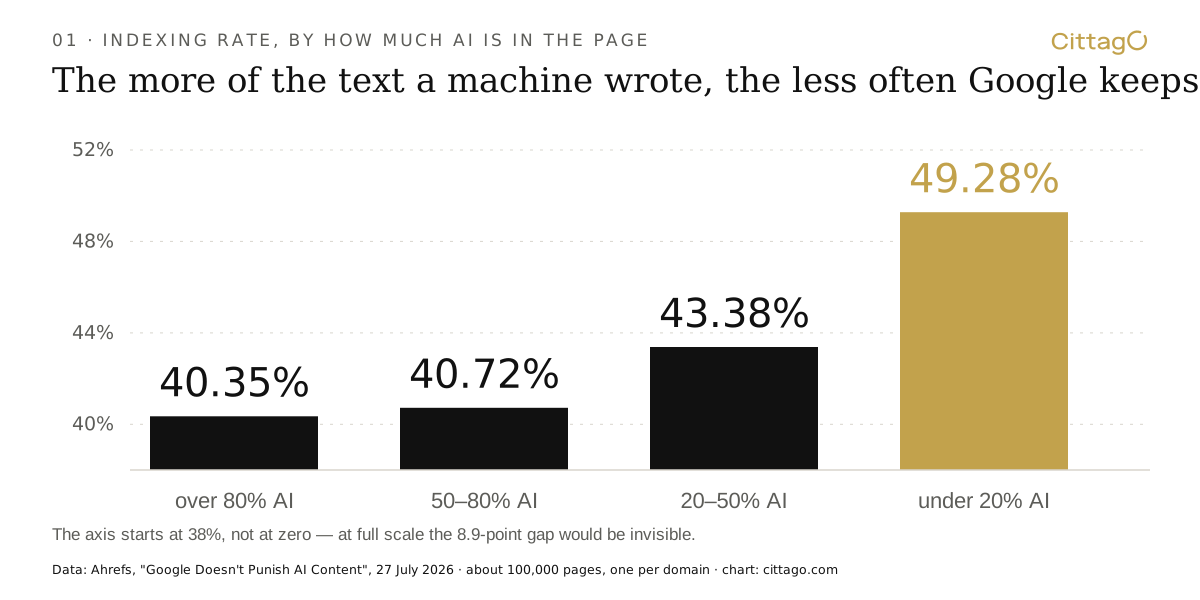
Pages with under 20% AI-classified text were found in the index 49.28% of the time. Pages over 80%, 40.35%. The two middle groups sit exactly where you'd expect: 43.38% and 40.72%.
Two things follow, and the second is the one people skip.
First, the gap is real and it is almost three times the ranking gap. Second, fewer than half of all pages get indexed no matter who wrote them. Even the most human group loses more than one page in two. The internet is full of pages Google declines to keep, and human writing is the majority of them. The difference between groups is not the difference between working and failing — it is 49 against 40.

Four gates, and AI text loses at the third
The two numbers are not comparable, and the reason becomes obvious once you follow a page through its life.
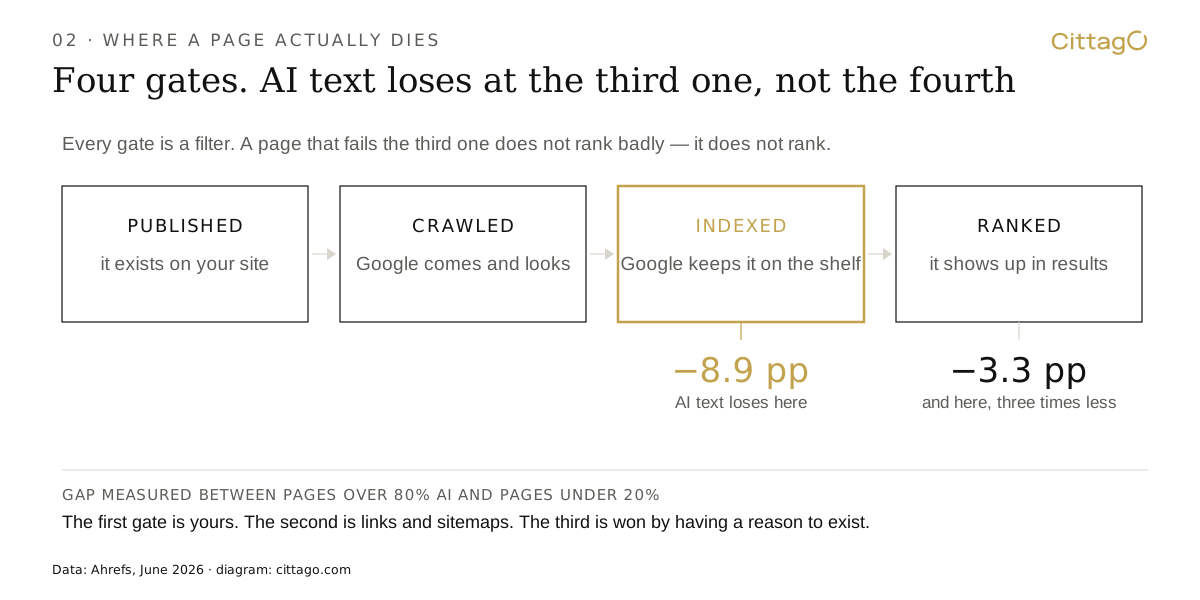
Gate one is yours: the page exists. Gate two is internal links, a sitemap and a server that answers — technical work, an afternoon of it.
Gate three is different in kind. Google decides whether the page earns shelf space. That is not a judgement about style. It is a judgement about point: does this add something the index doesn't already hold, or is it the thousandth restatement?
Only gate four is ranking, which is the only gate anyone writes about.
If you publish steadily and see nothing in Search Console, the question is not what position you hold. It is whether you are in the index at all. Two different problems, two different fixes, and the second one does not respond to writing more.
The ranking gap, for completeness
Here is the part that made the headlines, and it is worth having the actual figures rather than the summary of them.
| Measure | Position 1 | Position 10 | Gap |
|---|---|---|---|
| Mean AI score | 27.1% | 30.9% | 3.8 points |
| Median AI score | 17.1% | 19.5% | 2.4 points |
| Pages over 80% AI | 8.4% | 11.7% | 3.3 points |
Three rows, one story: there is a slope, and it is gentle. Ahrefs calls it "meaningful but far from disqualifying".
Pages under 50% AI hold 82.2% of all top-three positions. Which leaves nearly a fifth of the most valuable positions in search to pages that are mostly machine-written.
A gentle slope inside the first page is not a filter. A nine-point gap on whether you make the first page at all is.
One more figure for perspective: in last year's analysis, on a smaller sample, the correlation between AI score and position was 0.011. Effectively zero. What changed in 2026 is not Google's temper. It is that there is now enough generated content in the index for patterns to rise above the noise.
What an AI detector actually measures
Definition: an AI detector estimates, on a scale from 0 to 100, how closely a text resembles what language models produce — not whether a model produced it.
It reads patterns, not provenance: sentence length, how predictable the next word is, how even the rhythm stays. A methodical human writer with tidy paragraphs can score high. A generated draft rewritten properly can score low.
And the score belongs to Ahrefs, not to Google. Google has never confirmed that it runs a detector and publishes no such score. What the study establishes is a correlation between one company's classifier and positions in someone else's search engine. The authors say so themselves.
Terms, briefly
| Term | What it means |
|---|---|
| AI score | A detector's estimate, 0 to 100, of how closely a text resembles model output. Not proof of authorship. |
| Indexing | Google's decision to keep a page on the shelf. Without it, the page cannot appear for any search. |
| Crawling | The robot visiting the page. It can happen without indexing following. |
| Average position | The mean of positions the page appeared at, weighted by impressions. Distorted easily when new pages enter. |
| Percentage point (pp) | The unit for the gap between two percentages. 40.35% to 49.28% is a gap of 8.9 percentage points — and, at the same time, a relative increase of 22%. Same gap, two numbers, which is why there are two words. |
| Correlation | Two things moving together. It does not establish that one causes the other. |
What the study's author says
Ryan Law, who co-wrote the report, puts the conclusion in one sentence worth quoting whole:
"I don't think Google is trying to punish AI-generated content; I think it is relying on the same old hallmarks of content quality."
Google isn't hunting machines. It is applying the same quality signals it always has. Text produced quickly and shipped unsupervised fails those signals for the same reasons human text written quickly always did: nothing new, no sources, already said.
The distinction changes what you do. If the problem were AI, the fix would be to stop using it. If the problem is quality, use it — and supply the part it cannot.
How to check your own site in fifteen minutes

You need nothing you don't already have.
- Search Console, verified on the domain. The report you want is Indexing → Pages, not Performance. Almost everyone opens the wrong one.
- A count of what you published in the last three months. From a sitemap, an export, or your own memory.
- Fifteen minutes. No paid tool, no detector.
Compare indexed pages against published pages, then read the reasons under "Not indexed". Discovered — currently not indexed is gate three, exactly. Crawled — currently not indexed is the same gate, one step further in.
If dozens of pages are sitting there, you have found your problem, and it has nothing to do with who wrote the text.
What the study does not say
| What the study shows | What you cannot conclude |
|---|---|
| High AI score ↔ lower position | That a machine wrote it. The detector estimates resemblance to generated text, not its origin. |
| A lower indexing rate | That Google filters on AI. It may be filtering on repeated topics, missing links or domain age — all correlated with publishing at volume. |
| A pattern across 150,000 pages | What happens on your site. A population trend is not an individual diagnosis. |
| Data from June 2026 | That this holds in six months. Last year the same correlation was 0.011. |
| Pages of 350 words or more | Anything about short pages — product listings, contact pages, category pages. They were excluded. |
And a limit of ours, stated plainly: we do not know our own AI score. The detector is Ahrefs', sold inside their tools, and we don't have it. So we cannot tell you "our articles score X". We can only tell you what we changed and what happened next.
What we changed, and the week after
We publish daily with AI, signed Cittago. That makes us the sample this study is about, so here are our numbers.
Chronology first, or the figures mean nothing. This site went live on 6 July 2026. We published before that — two articles on 12 July, one on 22, two more on 27 — but those were written to exist, not built for search and for AI assistants. No figures of our own, no questions, no sourced claims.
The deliberate work starts on 27 July 2026, with an article about a Google Ads target CPA change. Eight articles in the seven days since. So read what follows as one week of work, not as a month.
| Week | Clicks | Impressions | Average position |
|---|---|---|---|
| 20–26 July | 1 | 239 | 32.6 |
| 27 July – 2 August | 34 | 1,037 | 11.4 |
On the 28-day window, pages with impressions went from 21 to 139. That is gate three, measured on us: not position, but how many pages got shown to anybody at all.
A few individual points, so it isn't only averages: our article on ChatGPT advertising in Europe sits at position 6.1 with 15 clicks; the query "chatgpt ads in europe" finds us at 2.5; and an article published on 2 August took 30 impressions and a click on its first day. In Analytics, organic search sessions went from 2 to 36, and one session arrived through the "AI Assistant" channel — one, so it is a note, not a trend.
We like the experiment and we publish the parts that don't flatter us. What we are not claiming: that any of this proves something about an agency's quality. At one week of work, it doesn't. Let's talk again in 3–6 months 😉
The editorial changes themselves
| Before | Now |
|---|---|
| Topics from an editorial calendar | Topics from the real queries in our own Search Console, and from the last 48 hours of news |
| Figures taken wherever | Every figure with its chain of custody: where we read it, not where we assume it came from |
| Three languages translated from English | Each language written from an outline, different section order, checked with a script |
| Two questions in the Q&A | Eight to ten, because each becomes a separate node in the structured data |
| Charts as images | SVG with the numbers in the markup, a data table on the page, and a plain-text version of the article for agents |
The last two rows are the ones that touch gate three directly. A page carrying a table of figures nobody else has is a page with a reason to be kept. A page retelling a news story is not.
And the part it would be convenient to skip, given that we publish daily: volume is the real risk, not AI. When writing gets cheap the temptation is to cover ten niches a week. That is precisely what produces dozens of near-identical pages, and gate three stops them all at once. We publish daily because we have a figure from our own account every day that nobody else has. On a day we don't, that day gets no article.
We wrote separately about how fast an article built this way reaches position, in four days old, and second in five countries, and about reading your own query list in the strange Search Console queries written by AI.
Where you are, in three thresholds
Open the indexing report and see which one describes you.
- You publish rarely and nearly everything is indexed. You do not have an AI problem and you are not going to get one. The next step isn't "write more", it's "write something that doesn't exist" — a figure of yours, a test you ran, a price nobody publishes.
- You publish a lot and half of it sits under "Discovered — currently not indexed". This is where most sites that accelerated with AI end up. Rewriting the text to sound more human does not fix it. Cutting does: fewer pages, each with a clear reason to exist.
- Everything is indexed and nothing brings clicks. Now you are at gate four, which is ranking. This is the only case where the argument about writing quality is the right argument.
We are at the second threshold with a foot in the third, and we are writing this a month after launch.
If you want this checked against your own site, SEO and AI search is where we usually start.
Questions with answers we think are useful
This article is hours old, so nobody has asked anything yet. These are the questions a reasonable reader would have, plus the ones that come up in real conversations with clients.
Will Google deindex content it thinks was written by AI?
Nothing in the data suggests removal. The study measures how often pages are found in the index in the first place, not pages being taken out of it. Pages over 80% AI still reach the index 40.35% of the time, and 5.3% of top-three results are fully generated.
Deindexing does happen, but under the spam policies, and those are about intent and pattern — scaled content abuse, doorway pages — not about which tool produced the sentences.
Does Google's spam policy cover AI content?
It covers scaled content abuse: producing many pages primarily to manipulate rankings rather than to help people. Automation is how that is usually done now, so the two get conflated, but the policy is written about purpose and scale, not about authorship.
The practical test is uncomfortable and useful: if you removed the automation and had to write these pages by hand, would you still want them to exist? If not, they are the pages the policy is describing.
If I rewrite an AI draft, does it still count as AI content?
For Google the question doesn't arise in that form — there is no trace in a text that proves where it came from. A detector estimates resemblance, not provenance, and a properly rewritten draft scores low anyway.
What matters after the rewrite is what you added. A figure of your own, a real example, a measurement: those change exactly what gate three looks at. Changing the words so they sound different changes nothing that counts.
Should I disclose that an article was written with AI?
Google does not require it and does not reward it. It is an editorial decision, not an SEO one.
We sign ours as Cittago and say openly that we use AI, because the alternative — implying a person sat down and wrote it — is a claim we would rather not make. That is a position, not a ranking tactic.
Does this affect being cited by ChatGPT and other AI assistants?
Directly. Assistants don't have an internet of their own: they search the existing engines and read what comes back. A page that isn't indexed doesn't appear in results, so it cannot be read and cannot be cited.
Indexing is the minimum condition for AI visibility, not a separate chapter. We wrote about the distance between being found and being mentioned in why ChatGPT won't recommend your company.
I have 200 pages and 60 indexed. Is that the AI?
Probably not first. An indexing rate of 49.28% for the most human group means partial indexing is the norm on the web, not the exception.
The usual causes, in the order worth checking: pages that are near-duplicates of each other, pages with no internal links pointing at them, a young domain, or simply more pages than the site's standing supports. AI makes all of them worse because it makes publishing cheap.
Why is 8.9 percentage points "a lot" and 3.8 "a little"?
Because they measure different things. The 3.8 points is a difference in mean score between position 1 and position 10 — a slope among pages that all made the first page already.
The 8.9 points is the difference between competing and not competing. An effect that applies before the contest weighs more than one that applies during it.
Does any of this apply to an online shop?
Partly. The study only looked at pages of 350 words or more, so short product pages were excluded and nothing here can be said about them.
The mechanism does apply. A shop with thousands of descriptions generated from one template has a gate-three problem by construction, and the fix is about how many pages deserve to exist, not about prose.
Can I use a detector to check my own drafts?
As a quality gate, it is close to useless. Detectors produce false positives on very orderly writing and false negatives on generated text that has been rewritten, so you could end up rewriting a good article to fool a tool that decides nothing at Google.
The useful question is different: does this page contain at least one thing that exists nowhere else on the open web? If not, the detector score is the least of your problems.
How often do conclusions like these change?
Quickly. Last year the same correlation measured by the same company was 0.011 — effectively zero. This year there is a visible slope, not because Google hardened but because the volume of generated content grew enough for patterns to show.
The practical conclusion has been stable throughout, though, and never depended on these figures: a page that brings something which exists nowhere else passes every gate.
Last updated: 3 August 2026. The figures on positions and indexing come from the Ahrefs report published on 27 July 2026 by Ryan Law and Xibeijia Guan, read directly, with coverage in Search Engine Journal on 30 and 31 July. The cittago.com figures come from the Search Console API and the GA4 API, weekly windows ending 2 August 2026.