ChatGPT sends traffic to travel. Just not to your hotel
Travel is the category where ChatGPT links out most. Those links almost always land somewhere other than the property itself. We tested 14 Italian hotels and B&Bs to find out why — the answer is simpler, and more fixable, than it looks.
Cittago runs this as a service — see seo agency cluj-napoca.
Ask ChatGPT where to stay in Puglia for three nights in September and you will get an answer with links in it. Follow them. One goes to a review platform, one to a travel guide, one to a booking site. The hotels named in the answer are real, established, often excellent. None of them is the source.
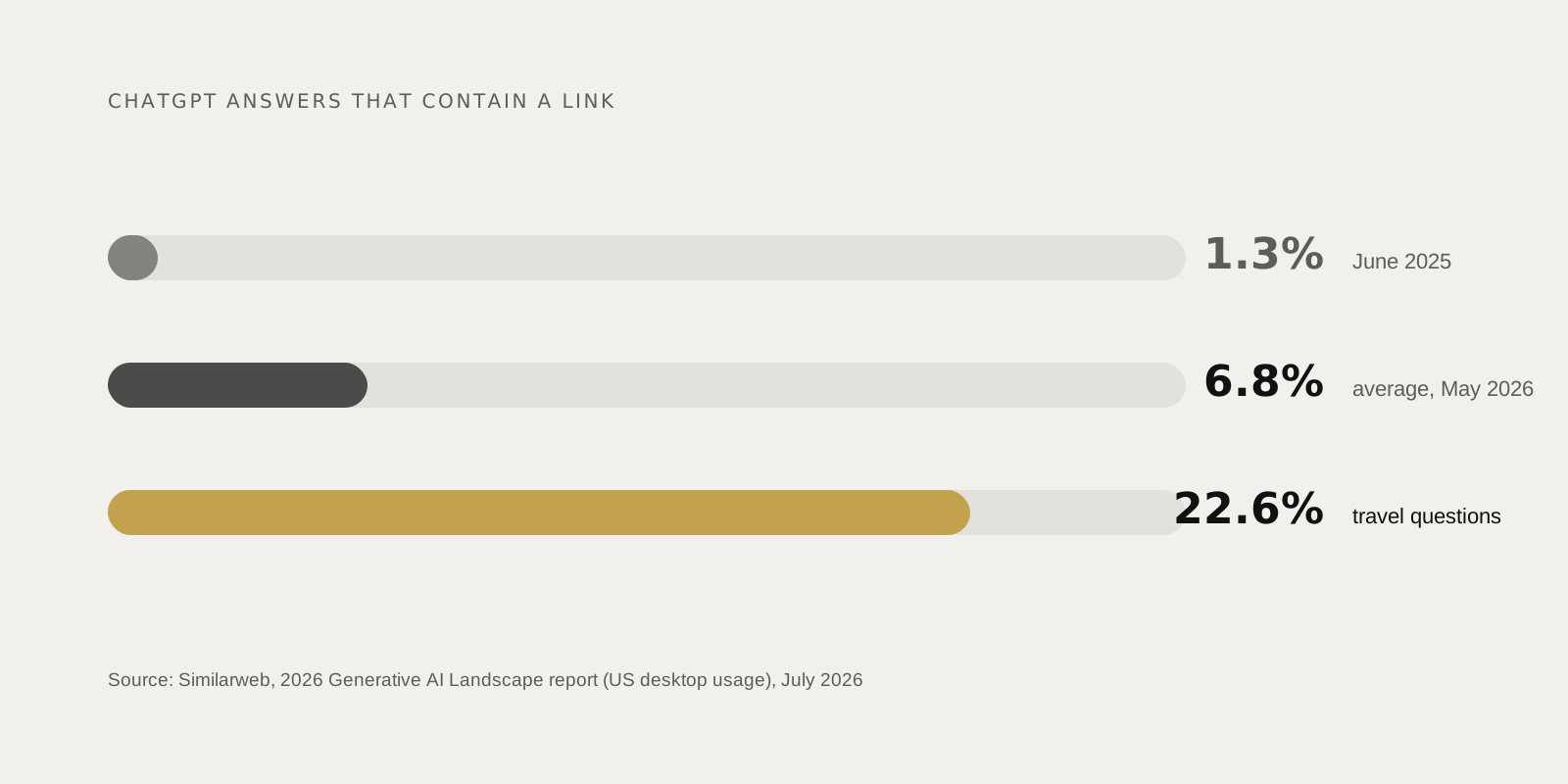
Travel is the single category where ChatGPT links out most: 22.6% of answers, against a 6.8% average (Similarweb, May 2026). But more than half of those links go to review sites rather than to the properties themselves. We tested 14 independent Italian properties: none exposed its own reviews in a format an AI can read, and 5 of 14 could not be reached by a crawler at all.
How often does ChatGPT link out?
Not often, but far more than a year ago. In May 2026, 6.8% of answers contained at least one link to an external site. In June 2025 it was 1.3% — a fivefold increase in under a year (Similarweb, 2026 Generative AI Landscape report, via Search Engine Journal, 27 July 2026).
The average hides the interesting part. Split by topic:
| Topic | Answers with a link |
|---|---|
| Travel | 22.6% |
| Retail | 13.5% |
| Sports | 10.7% |
| Finance | 8.0% |
| Average | 6.8% |
| Education | 4.8% |
Travel is not slightly ahead, it is three times the average. That makes sense. Someone planning a trip wants names, addresses, prices and availability, and a language model cannot produce those from memory — it has to go and read them somewhere. One caveat worth stating: Similarweb measures US desktop usage and works from estimates, so the exact percentage will move. The gap between travel at 22.6% and education at 4.8% is too wide to be noise.
So why doesn't that traffic turn into direct bookings?
Because the links exist, they just point elsewhere. In the same analysis, 54.1% of citations on travel content go to review sites and user-generated content. The assistant describes your property by reading what other people wrote about it.
That costs you twice. You lose control of the story, because the source is a review from two years ago on a platform you do not own. And the path to the booking runs through an intermediary, which means the reservation arrives with a commission attached. It is the zero-click problem landing in an industry where the direct booking is the whole margin.
The test: 14 Italian properties, none of them citable
So we asked the practical question: when the moment comes, are these sites even ready to be cited? On 28 July 2026 we took 14 independent Italian properties — one- to four-star hotels, B&Bs, agriturismi and masserie across Verona, Sirmione, Cinque Terre, San Gimignano, Alberobello, Ostuni and Matera — and fetched each home page without executing JavaScript, which is how the ChatGPT and Perplexity crawlers read a page.
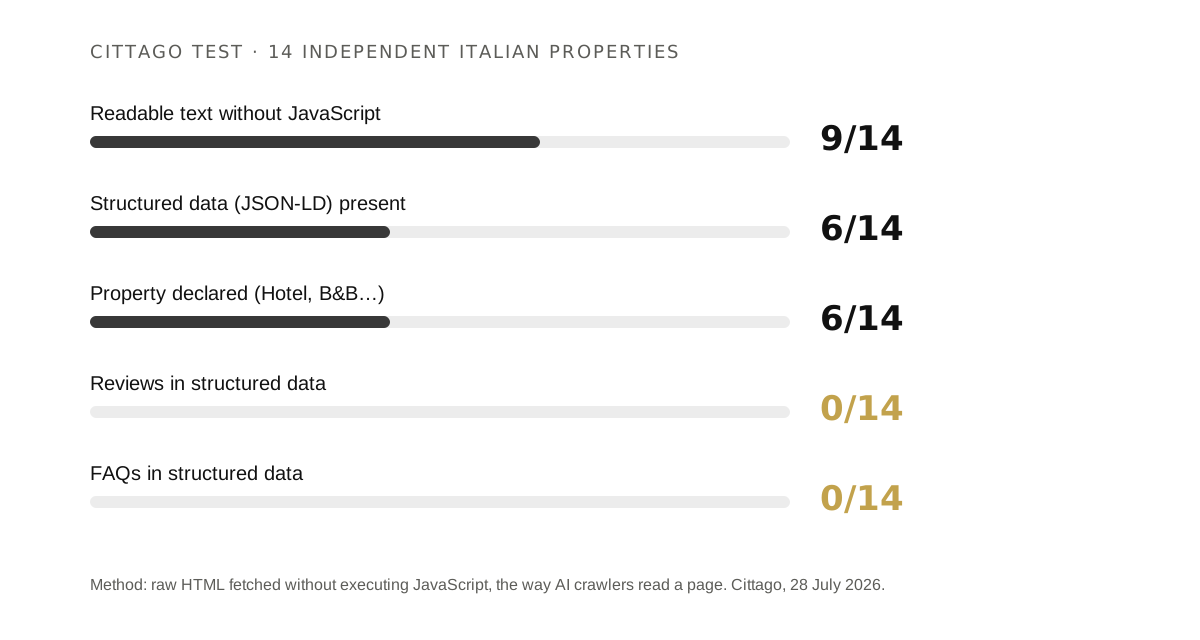
Nine returned real, readable text. Six had JSON-LD structured data, the format a site uses to tell a machine what it is and what it offers. Then the number that stopped us: zero of the fourteen declared their own reviews in that format. Zero had a marked-up FAQ section.
The five that failed deserve their own paragraph, because there the problem sits below the content:
- Two responded perfectly, with an empty page. Status 200, no errors, 77 characters of text. The site assembles itself entirely in JavaScript: lovely in a browser, non-existent to anything that does not run it.
- One returned a 404 on its own home page. A hotel's official site, unreachable at its own address.
- One timed out on connection, most likely an anti-bot filter that cannot tell a scraper from an AI assistant.
- One failed the TLS handshake — a certificate problem that ends the conversation before the page is ever requested.
To be clear: this is not a comment on how those businesses are run. Several are lovely and busy all season. It says that on the fastest-growing discovery channel they are currently silent — and that closing the gap is not a redesign, it is four technical details nobody ever asked them to fix.
Why a beautiful site can be invisible to AI
Because the beauty lives in the browser, and the crawler never opens one. If your room descriptions appear only after JavaScript has finished working, an AI assistant sees little more than the page title. It is the same reason speed and AI-readability are the same job: both come down to how much real content ships in the initial HTML.
Reviews are the currency, and nobody declares them
Back to that 54.1%. If assistants mostly cite review sites when they talk about travel, the answer is not to resent TripAdvisor. It is to stop being the one place on the internet where your reviews do not exist. The reviews guests have already left you on Google can live on your own site, with their text and their rating, declared in JSON-LD.
We do it to ourselves, and you can check: our 21 Google reviews are published in full and marked up in structured data, with the real 5.0 average. That is not a technical flourish. It is the difference between an AI having to look elsewhere for what people say about you, and finding it at your address, current.
The fixes, in order
Frequently asked questions
Can my hotel be recommended by ChatGPT?
Yes, but two separate things have to be true: the assistant has to find information about you at all, and your site has to be readable and citable when it decides to link. The first is already happening. The second is on you.
Do I need a new website to get cited by AI?
Almost never. In our test the failures were missing structured data, undeclared reviews, an expired certificate and an anti-bot filter. Those are hours of work, not months. A rebuild is the answer only when every piece of content exists solely in JavaScript.
Do AI assistants cite hotel sites or the big platforms?
Mostly review sites and user-generated content today: 54.1% of citations on travel content (Similarweb, May 2026). Your own site enters the picture when it holds what the others do not — current prices, availability, precise answers — in a readable format.
How do I know whether I am citable?
Start with step 01: load the site with JavaScript disabled. Then check that you have property JSON-LD and marked-up reviews. If you would rather not do it alone, we can look together in fifteen minutes.
Where Cittago comes in
We have worked with hospitality businesses for years, and the unglamorous part is always the same: making a site legible to machines without ruining it for people. We do SEO and AI search visibility, sites that serve real content without waiting for JavaScript, and the quiet work around them — structured data, reviews, speed. If you want the method before the conversation, start with how to get cited by AI assistants.
22.6% of travel answers carry a link. The question is not whether AI will talk about your property — that is already happening. The question is whether it cites you when it does.