Zero-click: customers now choose you without opening your website
Roughly 93% of searches in Google AI Mode end without a single click to any website (Semrush, 2025). That number scares a lot of people. We read it differently: your customer’s decision is still built on your website — it’s just that its first “visitor” is no longer the human, but the AI that reads it and makes the recommendation.
By Cittago, a digital studio in Cluj-Napoca since 2011

If you’ve opened Google Analytics recently and organic traffic looks thinner than a year ago, you’re not alone — and most likely, you didn’t break anything. What changed is where the answer gets consumed: more and more often, people get it right on the search page or inside a conversation with an AI — without ever clicking through. The useful question is no longer “how many visits do I get” but “who does the answer cite”.
In Google AI Mode, ~93% of searches end without a click to any website; with AI Overviews, ~43%; in classic search, ~34% (Semrush, a study of ~69 million sessions, 2025). That doesn’t mean your website stopped mattering — it means it’s read more and more by AI and less and less by humans. The new prize: being the source the AI cites when your customer asks. There’s a discipline for this — it’s called GEO, and it’s SEO’s younger sister.
What changed, in numbers
Semrush analyzed almost 69 million Google search sessions (US, desktop, May–July 2025) — one study, one methodology, so the numbers can genuinely be compared with each other. The conclusion is hard to look away from:
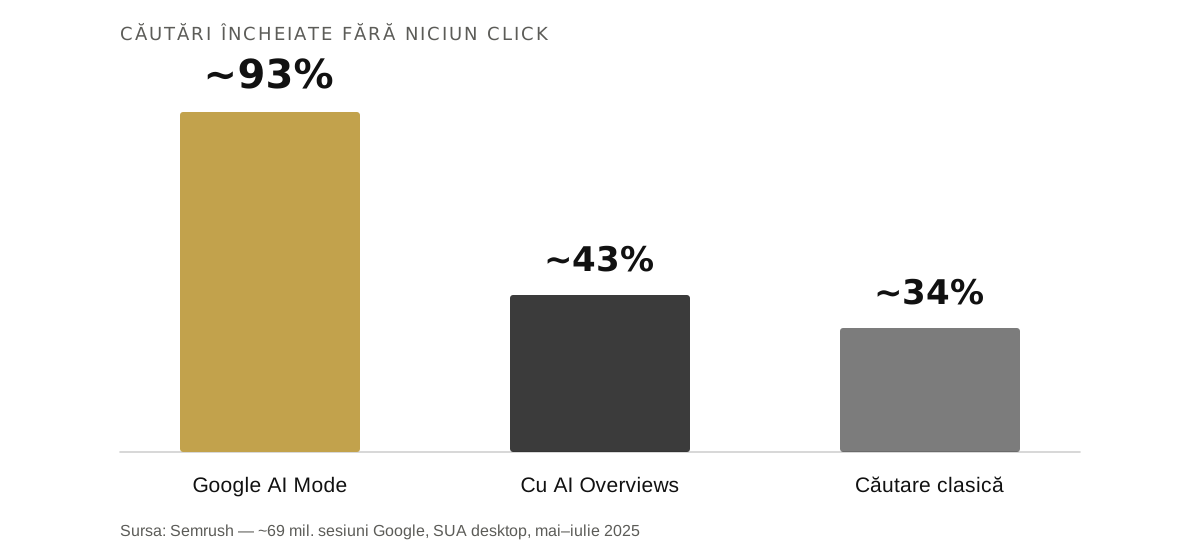
Read that last number again: of all AI Mode sessions, only 6–8% reach any external website. When clicks get that rare, they stop being shared out democratically: they go almost entirely to the sources the AI cited in its answer. Every other website doesn’t get “less” — it gets nothing.
Why this isn’t the end of your website
It sounds paradoxical, but it’s precisely in the zero-click world that your website becomes more important, not less. To answer at all, the AI has to do its homework somewhere: it reads pages, compares sources, picks who to cite. Your website is no longer just a shop window for people — it’s the press kit the AI consults before recommending you or skipping you.
And there’s one more piece of good news, valid right now: most of your competitors are doing nothing about any of this. When few prepare, the ones who do devour the citations — we saw the same mechanism at work when we wrote our GEO vs SEO guide. That window won’t stay open forever.
A story
Monday morning, two reports
Picture a guesthouse owner near Cluj opening Analytics on a Monday morning: organic traffic, down 30% on last year. First instinct: something broke. The website? Google? The agency?
Then he opens the second report: booking requests. Steady. If anything, slightly up. Guests are arriving “out of nowhere”: they asked an AI assistant for a quiet guesthouse near Cluj, got three recommendations, and his place was one of them. They never visited the blog. They called directly.
Traffic measures visits. A business lives on decisions. And decisions have started happening before the click.
Visits or decisions: what you optimize now
For years, the customer’s path looked the same: you show up in the results, you get the click, they browse your website, they send an enquiry. Every stage was measured, every stage was optimized. The new path is shorter and far less visible: the person asks, the AI reads and answers citing a handful of sources, trust forms right there in the conversation — and the contact arrives directly: a phone call, an email, a booking.

In practice, part of the marketing work moves one step earlier: before you convince the person, you have to convince the machine that filters their options. And the machine isn’t won over by slogans — it’s won over by content that is clear, verifiable and easy to quote.
Becoming the answer: five concrete moves
An honest tradeoff: where you stop competing
Let’s say the uncomfortable part too: generic informational articles — “what is X”, “how does Y work” — are exactly where the AI answers on its own and the click dies. If your content strategy was to pull traffic on topics like these and sell something later, that model is weakening by the day. The smarter move is to shift your energy toward what the AI cannot answer without you: your actual offer, your prices, your area, your proof. That’s where citations turn into customers, not just visits.
Frequently asked questions
My organic traffic dropped. Is AI to blame?
Quite possibly, at least in part — especially on informational pages, where the answer gets consumed right in the search results. Check Search Console: if impressions held steady while clicks fell, that’s the typical signature of AI answers, not of a penalty.
Is SEO still worth investing in?
Yes — but SEO that also feeds AI citations, not just rankings. The fundamentals stay the same (good content, structure, authority); the target changes: from “position 1 in the results” to “the source cited in the answer”. We compared the two disciplines in GEO vs SEO.
How do I check whether the AIs recommend me?
The simplest test: ask ChatGPT, Perplexity and Google (AI Mode) exactly what one of your customers would ask — “best guesthouse near Cluj”, “plumber in your town” — and see whether you show up, and how you’re described. Repeat monthly; the answers change.
Does the website still matter if people stop visiting it?
More than ever — it’s just that its audience has doubled: people and machines. The AI reads it to decide whether to recommend you, and the person who does land on it is closer to a decision than ever. A weak website now loses twice.
What counts as a zero-click search, exactly?
A search that ends without the person opening any result. The answer was on the results page — in an AI summary, a featured snippet, a knowledge panel, a map card — and it was enough. It is not the same as a search where somebody clicks a competitor. In the data those two look identical from your side: an impression with no click. Separating them is why the query-level view matters more than the sitewide one.
Does this hit commercial searches as hard as informational ones?
No, and the difference is the whole strategy. A question with one correct answer — opening hours, a definition, a conversion — is exactly what an AI summary is good at, and those clicks are largely gone. A decision that costs money still ends on somebody's website, because people want to see prices, proof and a face before they commit. Losing the first kind while keeping the second is a survivable trade.
How do I measure this in my own Search Console?
Compare two equal windows — the last 28 days against the 28 before — on impressions and clicks separately, not on CTR. Impressions flat or up while clicks fall is the zero-click signature. Impressions falling too is a different problem: you lost position, not the click. Do it per query group, not sitewide, because one page can mask the other.
If an AI cites us and nobody visits, how does that become money?
Through the searches that come afterwards. Somebody who was given your name and then types it into Google is a branded search, and branded searches convert far better than the informational visit you lost. The honest version: it is slower and harder to attribute than a click, and anyone who promises you a clean attribution chain for it is selling something.
What should we stop doing?
Writing pages whose only job is to answer a question that has one answer. That page used to earn a visit; now it earns a sentence in somebody else's summary. Keep the ones that carry a judgement, a number you measured, or a process only you run — those are the pages an assistant has to cite rather than paraphrase.
Where Cittago comes in
We’ve been working on exactly this boundary for a while: SEO services built for AI search — from content structure and structured data all the way to monthly tests inside the AI assistants. On our own website we apply everything we recommend — including the principles of the AI search era — precisely so we can see, on real data, what works before we propose it to a client.
Traffic was only ever a means. The goal was always the same: to be chosen. In the zero-click era, you’re chosen twice — first by the AI, then by the human.
Last updated: 26 August 2026. The 93% figure is Semrush's, from its Google AI Mode study of roughly 69 million sessions; the 68% figure in the sources line is a separate Search Engine Land study with a different methodology, and the two are not interchangeable. Neither number was recomputed by us. On this pass we rewrote the FAQ from four questions to nine, replaced the HTML entities in the source with the characters themselves, and pointed the service link at the phrasing people actually search.
SourcesSemrush — Google AI Mode’s Early Adoption and SEO Impact (study, ~69M sessions, 2025) · Search Engine Land — Google zero-click searches reach 68% in early 2026 (separate study, different methodology)
The test that matters
Is the AI recommending you, or skipping you? <em>Let’s find out.</em>
We ask the questions your customers would ask in ChatGPT, Perplexity and Google AI Mode, and show you exactly how you appear — or why you don’t. A short call, no strings attached.
Book a call