ChatGPT Ads reaches 31 European countries. Nine countries can buy them
Thirty-one European countries are getting ChatGPT ads next week. Nine countries in the world can open a ChatGPT advertiser account today, and exactly one of them is in Europe: the United Kingdom. Both numbers come from OpenAI, published four paragraphs and one help page apart, and almost every summary of this announcement quotes only the first.

What changed. On 18 August 2026 OpenAI published «ChatGPT Ads expands across Europe». The sentence everyone quotes: «Next week, ChatGPT Ads will expand to 31 European countries, including Germany, France, Spain, Italy, Sweden, Norway, Denmark, the Netherlands, and Austria.» The date of 24 August is not in that text — it comes from a German press agency wire. Ads appear only to users on the Free and Go plans.
Who can close the tab. If your company is registered in the United States, Canada, the United Kingdom, Australia, New Zealand, Japan, Korea, Mexico or Brazil, this is a straightforward market-expansion story and you already have an account. Everyone else is reading a different announcement than they think they are.
Why the rest should read on. Because «expands to 31 countries» describes where the ads are shown, not where they can be bought, and the second list has not moved. We read the official availability table on 20 August 2026 in a real browser — it has nine rows. The three routes OpenAI names for European advertisers are in the announcement, in one sentence that most write-ups compress into three words and lose.
- The nine rows of the official availability table, and the arithmetic inside OpenAI's own text that confirms them.
- Why a simple HTTP client cannot read that page, and why that is probably why so few write-ups cite it.
- The one question to ask any agency offering to run ChatGPT Ads for you next week.
- What our own Search Console shows: European demand for this topic existed a month before the product did.
There is a specific kind of error that costs a quarter, and it is not misreading a number. It is reading the right number off the wrong list. The ChatGPT Ads announcement contains two country counts that describe two different things, published in two different places, and nothing in either place warns you that the other exists. One is thirty-one. The other is nine. If you plan September on the first, you will spend three weeks discovering the second.
Two lists, read as one
There is a serving list: the countries where people see ads inside ChatGPT. And there is a buying list: the countries from which a business can open an advertiser account and place a campaign. The 18 August announcement is about the first. The help centre page is about the second. They do not overlap in the way the coverage implies.
Nothing about this is hidden, and nobody at OpenAI is being evasive. The announcement is a product announcement, the help page is operational documentation, and they were written for different readers. The failure is in the reading, which is why it is worth doing carefully once.
What the availability table says today
The «Ads Manager Availability» page in OpenAI's help centre holds a table with two columns, Country and Availability. We opened it on 20 August 2026. The page declared itself updated «7 days ago». The table had nine rows, every one of them reading «Available».
| Country | Region | Availability |
|---|---|---|
| Australia | Oceania | Available |
| Brazil | South America | Available |
| Canada | North America | Available |
| Japan | Asia | Available |
| Korea | Asia | Available |
| Mexico | North America | Available |
| New Zealand | Oceania | Available |
| United Kingdom | Europe | Available |
| United States | North America | Available |
Germany is not there. France is not there. Italy, named by OpenAI in the announcement itself, is not there. Below the table sits a line telling you what to do about it: availability «may continue to evolve as testing expands», and anyone outside those countries can register interest through an advertisers interest form. That is a waiting list, not a date.
That page cannot be read with curl, wget or any plain HTTP client: the request returns a verification screen of about ten kilobytes and no table at all. We rendered it in a real headless browser instead. This matters beyond our own workflow — it is a plausible reason why so many summaries of this announcement quote the press release and never quote the availability page. The page that contradicts the easy reading is the harder one to fetch.
The arithmetic that confirms it: one plus eight
A single table read on a single day is a weak foundation for an argument, so here is the check that makes it solid, and it comes from OpenAI's own announcement rather than from us. In the last section of that text, describing the platform's history: «In February, we began testing ads in ChatGPT with a pilot in the United States. Over the past six months, we have expanded to eight additional markets.»
One pilot market plus eight additional markets is nine markets. The availability table has nine rows. The two documents were written by different teams for different purposes and they agree exactly, which is the strongest evidence available that the table is current rather than a forgotten page nobody updated.
It also settles a question the announcement leaves open. The United Kingdom is already one of those nine markets, from before this announcement — so it is unlikely to be counted among the 31 European countries the product is now expanding to. We flag that as our inference from two OpenAI sentences, not as something OpenAI states.

What OpenAI actually announced
ChatGPT Ads is the system through which OpenAI sells advertising placements shown inside ChatGPT conversations, visually separated from the answers and labelled as ads, bought from a dedicated advertiser account. The definition is worth stating because of what it excludes: this is not a way to appear inside the answer. OpenAI writes that advertising does not influence the answers ChatGPT provides.
The platform section of the announcement describes something more built-out than most people assume. Bidding has moved beyond CPM and CPC to support conversion optimisation. Geo-targeting and custom audiences have arrived. Measurement has moved past clicks through the OpenAI Pixel, a Conversions API and third-party measurement integrations. OpenAI writes that «tens of thousands» of marketers have now advertised on ChatGPT.
Three routes for a European advertiser
Here is the sentence that decides your next month, quoted in full: «Advertisers will initially be able to access ChatGPT Ads through the OpenAI Ads Solutions team, agency partners, and technology partners. Self-service access through Ads Manager will follow later this summer.»
The OpenAI Ads Solutions team is direct sales, and direct sales has a floor. If your monthly advertising budget would fit inside that salesperson's travel expenses, you are not that channel's customer, and it is cheaper to know this now than after three unanswered emails.
Agency partners is the realistic route for a European SME in the next few weeks — with one condition that belongs in your first question rather than your third. The agency needs actual access, not the intention to request it. The check is one sentence long and independently verifiable: which country is the advertiser account registered in? If the answer is not one of the nine, there is no access behind the offer.
Technology partners means integrated buying platforms. Relevant if you already run one, irrelevant otherwise.
And a note on the calendar, because we would have liked someone to write it for us. «Later this summer» has different edges depending on which summer you mean: the meteorological one closes on 31 August, the astronomical one on 22 September. Three weeks of planning live in the gap, and OpenAI does not say which it means.
Who sees the ads, and who never will
The plan restriction is the least ambiguous line in the whole announcement, and it does two jobs: it sizes the audience, and it explains why you personally may never see the thing you are budgeting for.
| Aspect | Until now | From the week of 24 August |
|---|---|---|
| Where ads run | 9 markets, none in the EU | +31 European countries |
| Who sees them | Free and Go | Free and Go — unchanged |
| Ad-free plans | Plus, Pro, Enterprise | Plus, Pro, Enterprise — unchanged |
| Where you can buy | 9 countries with Ads Manager | Same 9, plus direct sales and partners |
| EU self-service | Does not exist | «Later this summer», no date |
So the European audience for ChatGPT ads is made of Free and Go users. Plus, Pro and Enterprise stay ad-free. In practice: the colleague in accounts will probably see them, and you, paying for Plus so you can work in it, will not. That asymmetry matters the moment somebody in a meeting says «let's have a look at one» and nothing appears.

Consent, the European half of the story
The difference between the American launch and the European one is not the product, it is the legal basis. A personalised ad means processing personal data, and processing needs a lawful ground. Digiday reported on 19 August that OpenAI will ask users for explicit consent and offer a choice between personalised and contextual ads, with the ability to withdraw. OpenAI declined to comment for that article.
European press accounts describe the launch as non-personalised at the start, with signals limited to the topic of the current conversation, approximate location, device type, time of day and language. OpenAI's VP of ads, Dave Dugan, told the German press agency DPA that advertisers will not have access to users' chat histories and that information from conversations will not be shared with advertisers.
For anyone planning a budget, the consequence is concrete: at the start you are not buying an audience, you are buying a moment. Someone who has just typed «I need a small hotel in Tuscany for three nights in October» is a context, not a profile. That resembles keyword advertising from fifteen years ago far more than it resembles what you do in Meta today — and for small companies that is good news, because a context is won with relevance rather than with data volume.
What you need to be ready
- A company registered in one of the nine countries, or an agency partner that already holds an account in one. Without one of the two, there is no buying route next week.
- Measurement that does not depend on the click. OpenAI names the OpenAI Pixel, the Conversions API and third-party integrations. If you measure clicks only, you will be buying without knowing what you bought.
- A consent banner that actually works on your own site. Not for ChatGPT's sake — because traffic arriving from there has to be measured, and a badly implemented consent layer breaks measurement in exactly the month you need it.
- Pages that answer the question in the shape it is asked. Somebody writing ChatGPT a thirty-word sentence about what they want is not typing a keyword. See what OpenAI changed about advanced matching on 17 August for the measurement half, and the July inventory of the European market for where this started.
- Budgeted patience. «Later this summer» is not a date, and a plan that needs one cannot rest on it.
What this announcement does not say
- It does not say which 31 countries. OpenAI names nine as examples and stops. The help page does not carry the list either. If someone shows you a complete list of 31 names, ask where it came from.
- It does not give a day. «Next week» in OpenAI's text; 24 August in the DPA wire. A supplier that does not publish a date has not committed to one.
- It does not say when EU self-service opens. «Later this summer», undefined.
- It does not say what anything costs. No published minimum budget, no indicative cost per thousand impressions, no rate card. Any figure you read today was estimated by somebody.
- It does not list the formats. The text speaks of «new formats» as something still to be developed, not as a catalogue available for Europe.
- It does not say whether the 31 include the UK. Our reading of the one-plus-eight arithmetic says probably not, and we mark that as a reading.
What we measured on our own property
We published an article about the state of ChatGPT Ads in Europe on 29 July 2026, four weeks before this announcement. It was not a prediction, it was an inventory: who could buy, who could not, and why the European Union was last. What happened to that page since is measurable, and more interesting than the page itself.
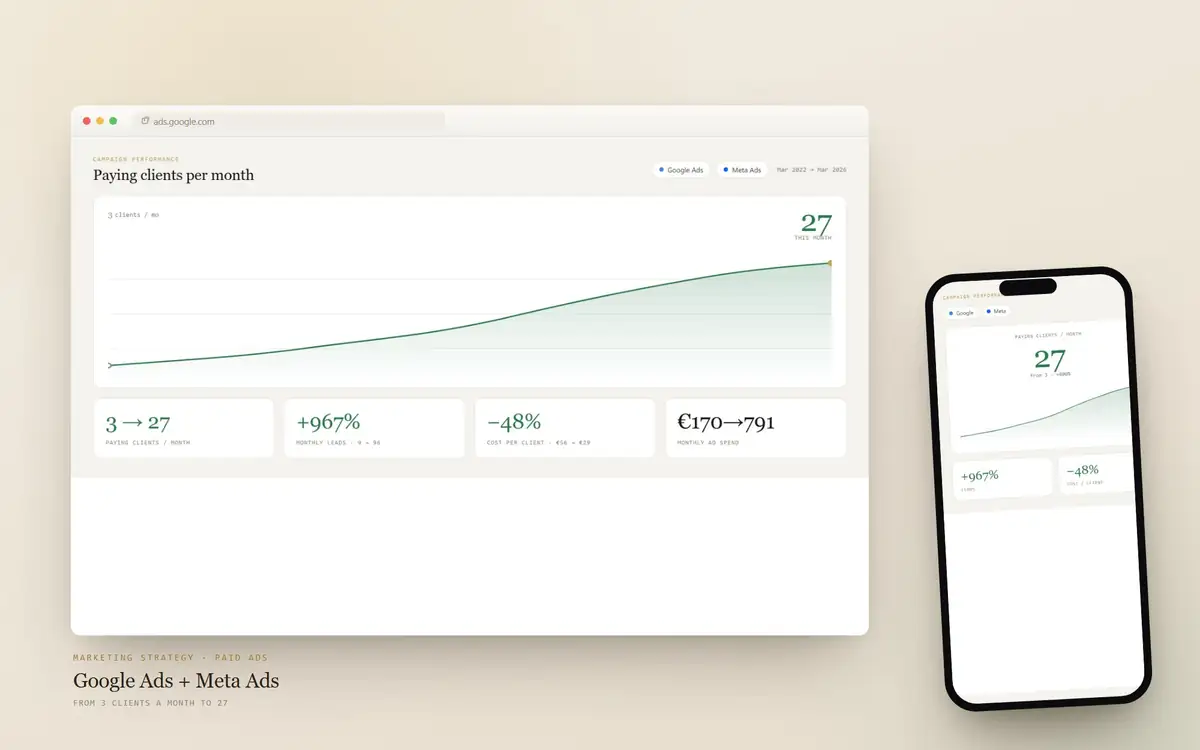
Over the last 28 days the English version collected 1,110 impressions and 60 clicks at an average position of 6.4 in Search Console. Those figures are for one URL, the English one, not for the three language versions together. The query «chatgpt ads europe» alone produced 14 clicks from 47 impressions at position 3.4, and «chatgpt ads in europe» a further 9 clicks from 24 impressions at position 2.1.
People in Europe were searching for «chatgpt ads europe» a month before ChatGPT Ads existed in Europe, and clicking through to an article that told them honestly that they could not do it yet. Demand for the information arrives before the product does — and before the competition for the topic does.
The three language versions did not behave alike. Italian: 35 impressions, 5 clicks, position 3.5 — a click-through rate of 14.3%. English: 1,110 impressions, 60 clicks, 5.4%. Romanian: 43 impressions, zero clicks, position 5.9. Same starting text, three different outcomes, and the smallest audience converted best.
The operational conclusion for a company that cannot buy next week: the only lever available from continental Europe this week is the organic one — being the company ChatGPT names when somebody asks who does what you do. It is not sold by a sales team and it does not wait for a country list. That is precisely what our SEO and AI search visibility service does, and it is the only thing in this article that can start today.

Glossary, for the meeting
| Term | What it means |
|---|---|
| Ads Manager | The self-service interface. Open an account, add a card, build a campaign. Available in nine countries. |
| Ads Solutions team | OpenAI's direct sales force. You buy through people, not through a form. |
| Go plan | ChatGPT's low-cost subscription. Together with the free plan it forms the audience that sees ads. |
| OpenAI Pixel | The measurement snippet you put on your own site, the equivalent of the Meta pixel. |
| Conversions API | Sending events from your server instead of the browser. Survives browser-level blocking. |
| Contextual ad | Chosen by the topic of the conversation rather than by the person's profile. Needs no consent for profiling. |
Where you stand, in three thresholds
Threshold one — your company is registered in the EU and you have no agency with access. Nothing changes for you as an advertiser next week. What changes is that your audience starts seeing other people's ads. The useful move this week is to register interest on OpenAI's advertiser form and spend the time on the organic side, where you are allowed to play.
Threshold two — you have an agency or technology partner with real access. You can test. The first question is not «what does it cost», it is «which country is the buying account registered in» and «how is this measured, if not by clicks». Without an answer to the second, a test produces an invoice rather than a decision.
Threshold three — you already have an entity in one of the nine countries. You are in the best position available in Europe, and it is a position with an expiry date: the advantage lasts exactly until self-service opens to everyone. What matters now is learning the format while the auction is still empty.
Questions
Can a company in the EU buy ChatGPT Ads from 24 August?
Not through self-service. On 20 August 2026 the official Ads Manager availability table lists nine countries and no EU member state is among them. The routes OpenAI names are its Ads Solutions team, an agency partner holding an account in one of the nine, or a technology partner.
How do I verify the nine-country list myself?
Open the «Ads Manager Availability» page in OpenAI's help centre and read the table: two columns, nine rows. You need a real browser — a plain HTTP client receives a verification screen and no content, which is a fair explanation for why the page is so rarely quoted.
Is the United Kingdom one of the 31 European countries?
OpenAI has not published the list, so there is no certified answer. The reasoning available is that the UK is already one of the nine markets where ads run, from before this announcement, so it is unlikely to be counted among the countries the product is expanding to now. That is our inference from two sentences in OpenAI's text.
Why do so many articles say Europe can now advertise on ChatGPT?
Because the press release describes serving markets and never mentions the buying list, and the buying list lives on a help page that a plain HTTP client cannot fetch. Neither document is wrong; reading only the first one is.
Who sees ChatGPT ads in Europe?
Only users on the Free and Go plans. Plus, Pro and Enterprise subscriptions stay ad-free, which means anyone paying for the higher tiers will not see the ads being discussed.
What does it cost?
There are no published European prices: no minimum budget, no indicative cost per thousand impressions. OpenAI writes that bidding has moved beyond CPM and CPC to support conversion optimisation, without giving figures.
What should I ask an agency offering to run ChatGPT Ads for me?
Two things, in order. Which country the advertiser account is registered in — if it is not one of the nine, there is no access. And how results are measured without counting clicks alone: the OpenAI Pixel, the Conversions API, or a third-party integration. An agency without a ready answer to the first is selling an intention.
Are the ads personalised using my conversations?
OpenAI's VP of ads, Dave Dugan, told the DPA news agency that advertisers will not have access to users' chat histories and that conversation information will not be shared with advertisers. European reports describe the launch as non-personalised at the start, with signals limited to the current conversation topic, approximate location, device type, time of day and language.
Should I wait for self-service or find an agency now?
It depends on one thing: whether you have anything to measure. If you cannot say today what a lead is worth from the channels you already run, a new channel will not tell you either. If you can, testing through an agency in the first weeks has the advantage of an auction nobody has crowded yet.
Could OpenAI move the date?
Yes, and the mechanism is visible in how it was communicated. A supplier writing «next week» rather than a day has not committed to a day. The 24 August date came from the press, and if it moves we will most likely learn that from the press too.
Last updated: 20 August 2026. OpenAI's announcement «ChatGPT Ads expands across Europe» is dated 18 August 2026 on openai.com and was read in full on this date; the quotations are reproduced from that text. The 24 August date does not appear in the announcement: it comes from a DPA news agency report of 19 August 2026, carried by the business press. The «Ads Manager Availability» table in OpenAI's help centre was read on 20 August 2026 in a real headless browser, because a plain HTTP client receives only a verification screen; it contained nine rows, all «Available», and the page declared itself updated seven days earlier. The consent detail comes from Digiday, 19 August 2026, an article for which OpenAI declined to comment. The non-personalised targeting signals and Dave Dugan's statement come from press reports of 19 August, not from OpenAI documentation. Our Search Console figures are for the cittago.com property, queried on 20 August 2026 over a 28-day window, and the per-page figures are for the single URL named in each case rather than for all three language versions together. We update this page when OpenAI publishes the list of 31 countries, an exact date, or Ads Manager availability inside the European Union.
Sources: OpenAI — ChatGPT Ads expands across Europe (18 August 2026) · OpenAI Help Center — Ads Manager Availability · Search Engine Roundtable — ChatGPT Ads Expanding To 31 European Countries · Digiday — OpenAI builds offerings on consent as it expands ChatGPT ads to Europe